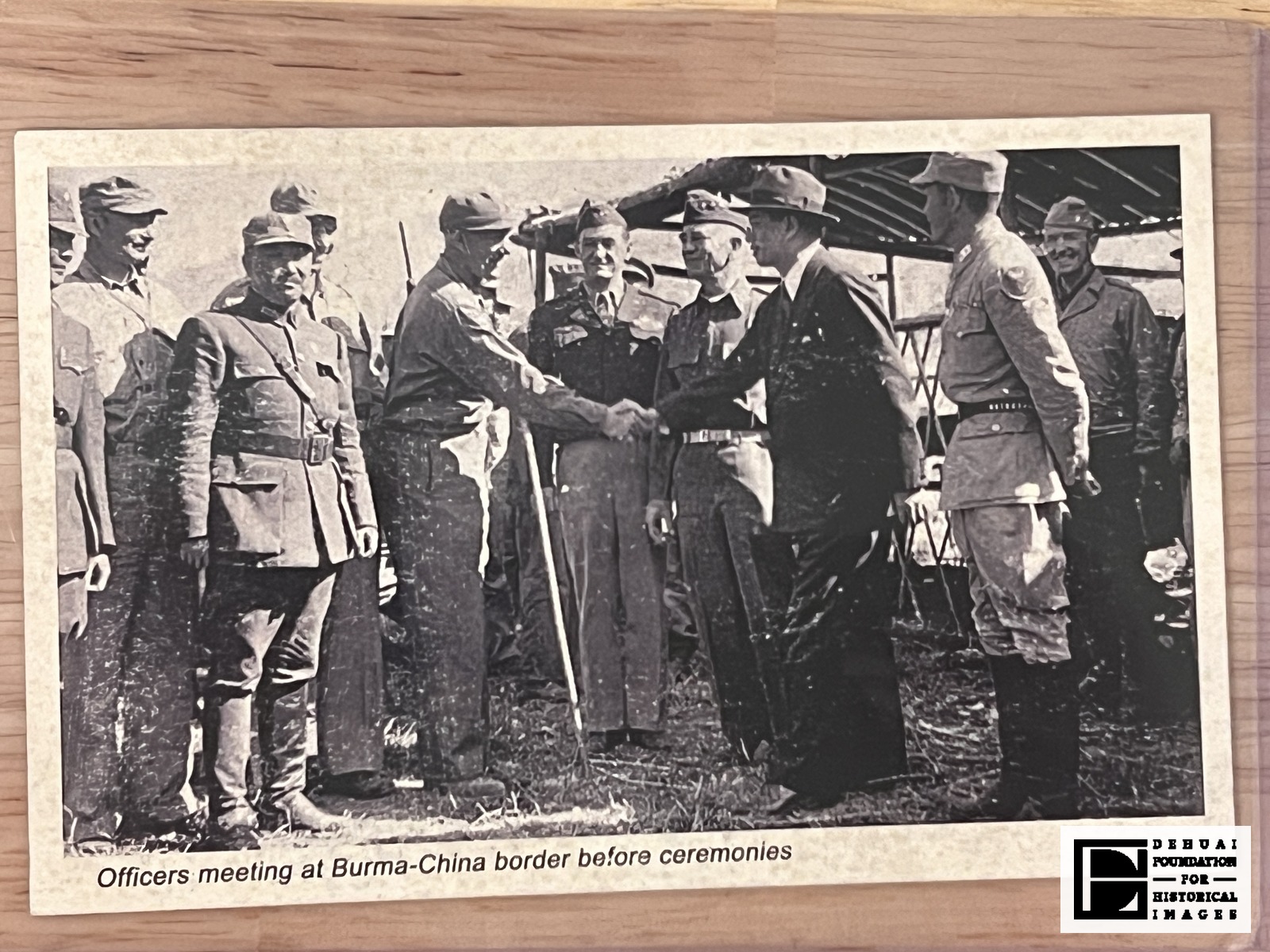
"Officers meeting at Burma-China border before ceremonies" — reproduction of a photograph
Men standing on rough grass in front of an open-sided shelter with a plank roof carried on posts. Two men at the centre shake hands. Around them about ten more men stand in a loose ring,…
The objectphotographed as held, uncropped
Catalogue description
Men standing on rough grass in front of an open-sided shelter with a plank roof carried on posts. Two men at the centre shake hands. Around them about ten more men stand in a loose ring, most with their hands at their sides; two or three at the edges of the frame are cut by it. One man at the left front wears a tailored tunic with a diagonal strap over the right shoulder, a waist belt with a squared buckle, breeches and high boots, and a soft visored cap. The men behind and beside him are in lighter shirt-sleeve uniforms and soft caps. At the centre and right are men in field uniforms and soft caps; one, seen from behind, has a round cloth patch on the shoulder nearest the camera — which shoulder that is cannot be determined from this view — and a webbing belt with a row of small eyelets at the waist. Thin dark verticals that may be rifle muzzles, and what appear to be pale furled cloths or flags on staffs, show above and between the standing men left of centre. Nothing in the frame identifies a place: no sign, no marker, no vehicle.
One man near the centre is not in uniform. He wears a dark suit jacket with lapels, a white shirt with a soft collar and a necktie, and a wide-brimmed dark felt hat, and his right arm runs into the handshake. The caption's word "officers" does not cover him. He is not identified, and no one else in the frame is identified either.
The object is a reproduction of a photograph rather than an original camera print, with the caption line set beneath the image; whether it was produced photomechanically, photographically or by photocopy is not established. It carries no photographer's credit, no agency stamp, no publisher, no series number and no date, so the object cannot say who made the picture, who printed it, or when. A full-phrase search of the caption returned no match in the results seen, so the publication it was cut or printed from remains unidentified.
The caption gives one line and names nobody: not the two men shaking hands, not a unit on either side, not a point on the border, not a date, not the ceremonies it says are still to come. What it does supply is what the picture does not — that this is the Burma–China border, and that the meeting precedes ceremonies. It names no army, no unit and no nation. The archive can go no further from the object. The uniforms of the left-hand group are consistent with Chinese Nationalist officers and those at the right with United States soldiers, but that reading rests on the clothing as reproduced here, not on any legible insignia; the round shoulder patch is not readable at this resolution.
Transcriptiontext on the object, as printed
Officers meeting at Burma-China border before ceremonies
Historical context
Mong-Yu, in northern Burma, is the junction where the Ledo Road driven from Assam meets the old Burma Road running into Yunnan. In January 1945 the Chinese 30th and 38th Divisions moved southeast towards Namhkam and met at Mong-Yu, and the first Allied convoy from Ledo passed through the junction on 28 January 1945; both statements rest on a single general-reference source, the Wikipedia article on Mong-Yu, and are attributed here rather than settled. Reaching the frontier reopened a land route into Yunnan that had been closed during the Japanese occupation of Burma. The convoy, under Pick, entered the Chinese border town of Wanting on the afternoon of 28 January 1945, sixteen days after leaving Ledo, and was received there by T. V. Soong, Gen. Wei Lu-huang, Gen. Sun Li-jen, Gen. Sultan, Maj. Gen. Francis W. Festing, and Maj. Gens. Chennault and Davidson (names, titles and spellings as printed in the source fetched). A frontier reception of commanders of that kind is the sort of occasion the caption's word "ceremonies" would name, but the archive has not matched this photograph to that event or to any other.
What is not known
- The object is undated and unattributed. No imprint, publisher, photographer credit, series number or copyright line appears on the face imaged.
- The date of this printing is not established, and the object may be a later reprint, photocopy or reference print rather than a wartime printing: no screen pattern is resolvable at the resolution imaged, the caption is set in an oblique grotesque closely resembling a modern Helvetica or Arial italic, and the stock reads white under contrast enhancement. The draft's readings of "coarse-screen halftone" and "a page from a wartime pictorial book or souvenir set" are guesses the object does not support.
- dc_type records the object as a Photograph for shelving; the physical format — cut page, photocopy or reference print — is not established.
- The reverse was not photographed; any printing, stamp, page number or annotation there is unrecorded. If the reverse exists in the collection it is the most likely route to identifying the source publication.
- The occasion is not established. The reopening of the Ledo/Burma road crossing at the end of January 1945 is the leading candidate, but the caption names no event and no source fetched by the archive matches this image to a documented ceremony.
- The point on the border is not established. The caption says only "Burma-China border"; the coordinates recorded are an indicative centroid at the Mong-Yu junction and are not the photograph's location.
- No terminus post quem is established. American officers were with Chinese forces on and across that frontier from 1942, so nothing excludes 1942 or 1943; nor is a date later in 1945 excluded. date_sort 1942 is the earliest year of the range stated in date_display and is an ordering value only; the floor rests on that presence, not on anything on the object.
- The subject term "military ceremonies" follows the caption's word "ceremonies" and is not independently established; no ceremony is visible in the frame.
- Sources conflict on the January 1945 sequence at Mong-Yu. The Wikipedia article fetched says the 38th Division met soldiers of Y-Force on 20 January without placing that meeting at Mong-Yu, while other accounts seen in search results date the clearing of the Mong-Yu junction by the New 38th Division to 27 January 1945. The archive did not resolve this: an attempt to fetch the Hyperwar text failed with a 404, and the discrepancy is left open rather than decided.
- No individual in the photograph is identified, and none can be identified from this reproduction — including the man in civilian dress at the handshake. The round shoulder patch on the soldier at the right is not legible.
- Whether the photograph originated as a US Army Signal Corps picture, a press-agency picture or a private one is not established; nothing on the object says so.
- The identification of the left-hand group as Chinese officers and the right-hand group as United States soldiers rests on the clothing as reproduced here, not on any legible insignia.
- A search on the exact caption phrase returned no match in the results seen, so the source publication is not identified.
- The ranks, first names and affiliations of the officers named in historical_context are given only as printed in the source fetched; the archive did not verify them elsewhere, and the sentence about the closure of the land route into Yunnan is stated no further than that source carries it.
TFA-CA-130, “"Officers meeting at Burma-China border before ceremonies" — reproduction of a photograph,” Photograph c. 1942–1945 (inferred from the uniforms and the caption's subject, not from anything on the object); this printing undated. Picturing Chinese America — Tarita Foundation Archive, 2026. Accessed [date].