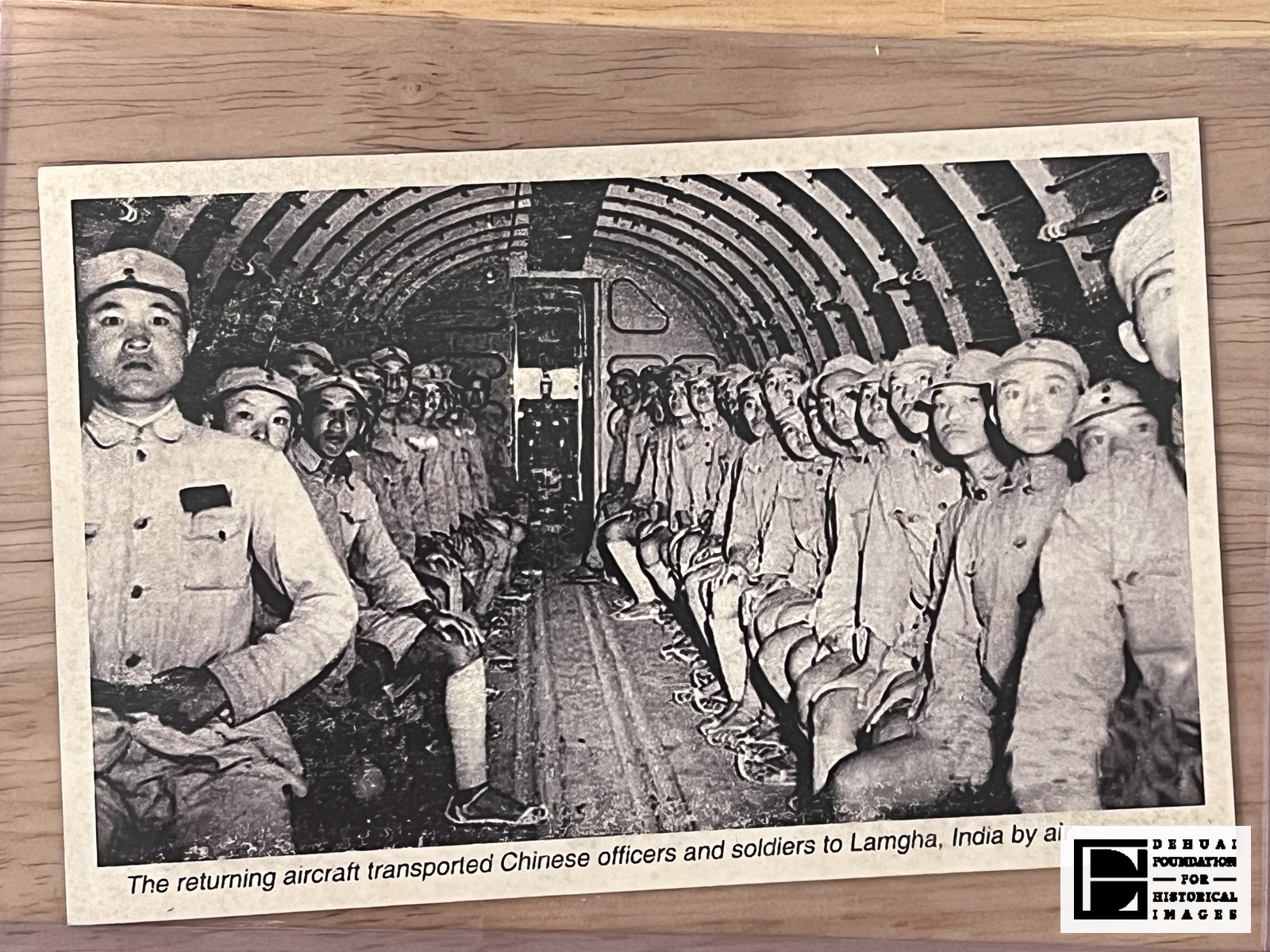
Photo card of men seated in an aircraft cabin, captioned as flown "to Lamgha, India by air"
The interior of an aircraft cabin. Curved ribbed formers arch overhead and repeat away down the length of the fuselage to a bulkhead at the far end pierced by a tall rectangular opening;…
The objectphotographed as held, uncropped
Catalogue description
The interior of an aircraft cabin. Curved ribbed formers arch overhead and repeat away down the length of the fuselage to a bulkhead at the far end pierced by a tall rectangular opening; rounded-cornered rectangular window shapes show in the fuselage side above the men's heads. Men in uniform are seated in ranks down both sides. The right-hand rank is the lit and legible one, a dozen or more men in soft caps running to the frame edge, most of them facing the camera. The left-hand rank falls into shadow behind the figure nearest the lens: a man in a light tunic, unlike the tunics of the men behind him, and a cap taller and lighter than theirs, a solid dark rectangle on the breast of the tunic, his hands resting in his lap. Between the two ranks the floor is bare and ribbed lengthwise; no seat structure is legible anywhere in the frame. Dark material lies on the floor at the lower left, outside the open floor between the ranks; what it is cannot be made out. Nothing in the frame carries a legible unit marking, aircraft number or insignia.
The object is a caption card: one photographic image reproduced with a single line of explanation printed beneath it; no imprint identifies the set, panel or publication it belongs to. It carries no credit, date or series number either, so the caption does all of the identifying work — the nationality, the ranks, the destination and the direction of the flight are supplied by the printed line and by nothing visible in the picture. The English of that line is not idiomatic: "transported ... to Lamgha, India by air", with "by air" left standing after the destination. That is consistent with a translation, though the archive has not established from what language, by whom, or for what publication.
The place name is printed "Lamgha". The archive has not found that spelling in any map or gazetteer of India it consulted, and no source it read gives "Lamgha" as a form of an Indian place name. The archive's reading, which no source establishes, is that "Lamgha" is a re-romanisation of the Chinese renderings 藍伽 / 蘭伽 / 蘭姆伽 [Lanjia / Lanjia / Lanmujia] used for Ramgarh, Bihar, where the Chinese Army in India was trained from 1942. That reading sets the geo field of this record and part of its historical context, and is provisional throughout. It is also not a clean equation: the official history caps the daily flow of Chinese troops at 650 men because Assam transportation facilities were congested. The archive reads that as placing the arrival end of the airlift in Assam rather than at Ramgarh, several hundred miles away; the source names no arrival airfield and says nothing about how the men completed the journey. If the movement was made in two stages, a caption reading "to Lamgha ... by air" would compress it into one.
The men are described by what was done to them — transported, by air, to a destination whose printed spelling survives on no map the archive found — and they are not named, numbered or given a unit. The caption supplies the identification the picture does not. Most of the men whose faces are lit are looking at the lens; the shadowed rank cannot be read.
Transcriptiontext on the object, as printed
FACE, single caption line in the lower margin:
The returning aircraft transported Chinese officers and soldiers to Lamgha, India by air

[No terminal punctuation. "Lamgha" is transcribed exactly as printed; the spelling was read at full resolution by two readers independently and is unambiguous.]

No other text appears on the face. Checked at full resolution: top, left, right and bottom margins are blank — no credit, photographer or agency imprint, date, plate, figure or series number, stamp, cancellation, ink or pencil annotation, or signature.

No Chinese-language text appears anywhere on this object.

Within the photograph: a solid dark rectangle on the breast of the tunic of the man nearest the lens. No lettering or other internal detail is resolvable on it at any available resolution — [illegible]. No other text appears inside the image.

REVERSE: not photographed.
Historical context
Ramgarh was a town in Bihar province, India; the district passed to the newly created state of Jharkhand in 2000. The United States Army's official history of Stilwell's mission records that the Generalissimo, Chiang Kai-shek, approved Ramgarh in Bihar Province as a site, and that on 2 July 1942 he gave Joseph Stilwell command of the Chinese Army in India; General Order No. 1, issued on 26 August 1942, formally organised the Ramgarh Training Center. As of December 1943 the centre had trained 5,368 officers and 48,124 enlisted men of the Chinese Army in India, principally the 38th and 22nd Divisions. It closed on 4 July 1945. The troops reached India for that training by air. The official history dates the start of the passage to 20 October, with some 4,000 flown to India that month; the Chinese soon passed the desired figure of 400 men a day, and theater headquarters had to limit the daily shipment to 650 because Assam transportation facilities were congested. The archive was not able to fetch a source carrying the account, which appears in secondary summaries, that these men travelled on the return leg of transport aircraft that had carried supplies into China over the Hump; that account is recorded in uncertainties as an open question and is not used here to explain the caption's opening words.
What is not known
- Nothing on the card establishes a photographer, agency, publisher, date, series or place of publication. All of those are unknown.
- The date of this printing is not established; the caption typeface is consistent with a later printing. Whether the card is a wartime object or a later commemorative, exhibition or book reproduction is unsettled, and no imprint supports a date either way. The archive can say only that the reproduction is coarse, high-contrast and posterised, which is consistent with a photomechanical reproduction rather than a print from an original negative.
- "Lamgha" is transcribed exactly as printed. Its identification with Ramgarh, Bihar is the archive's inference from the subject matter and from the Chinese renderings of Ramgarh (藍伽 / 蘭伽 / 蘭姆伽 [Lanjia / Lanjia / Lanmujia]; modern 拉姆格尔 [Lamuge'er]); no source read gives "Lamgha" as a form of the name. The geo field follows that inference and must carry the caveat wherever it is published, including in any map or index view.
- The archive did not find "Lamgha" in the maps and gazetteers of India it consulted; that is a failed search, not a demonstration that the spelling appears nowhere.
- The aircraft type is not established. The ribbed fuselage and cabin form are consistent with the twin-engine transports used on the India–China route, but no marking, window pattern or fitting in this reproduction is decisive, and the archive does not identify it.
- Which end of the aircraft the camera is at cannot be determined. The far end of the cabin is closed by a bulkhead with a rectangular opening that could be either a forward crew bulkhead or an aft compartment; no cockpit, cargo door or diagnostic window pattern is visible.
- The solid dark rectangle on the near man's tunic has a clean hard edge and no internal tone, weave, stitching or lettering at any available resolution. It is not established what it is: a name or unit tag, a metal plate, and a blackout applied at the reproduction stage are all consistent with what is visible.
- The clothing of the man nearest the lens differs from that of the men behind him — a lighter tunic and a taller, lighter cap — but nothing rank-bearing is resolvable at full resolution: no collar patch, shoulder board, badge or lettering, and whether the cap has a peak cannot be made out. He is described in this record without a rank; the word "officers" stands only inside the quoted caption.
- The dark material on the floor at the lower left is not identified.
- No individual in the photograph is identified, and no unit, division or rank can be read from the image.
- The direction and endpoints of the flight are not established by the object. The caption says the aircraft was returning and carried the men to India; the airfield of departure and the airfield of arrival are not stated, and nothing in the frame fixes them. No source the archive read names an arrival airfield, and none says how the men completed the journey from the point of landing to wherever they were taken next; the Assam arrival point given in the description is the archive's reading of a congestion sentence, not a stated fact.
- Whether the caption's phrase "the returning aircraft" refers to the documented practice of moving Chinese recruits on transports returning from Hump supply runs is an open question. The archive could not fetch a source carrying that account (the Pacific War Online Encyclopedia page for Ramgarh cannot be retrieved over HTTPS: the certificate covers kgbudge.com and not the pwencycl subdomain), so the connection is not asserted.
- The dates on which the divisions trained at Ramgarh returned to the front, and the relation of that training to the north Burma campaign, were dropped from this record: the only citation the draft had for them was a page that returned HTTP 403 and was never read.
- The language the caption was translated from, if it was translated, is not established, and no publication carrying this image was found by searches on the caption wording or on 蘭姆伽 [Lanmujia] / 駐印軍 [the Army stationed in India] 空運 [air transport].
- Only one face of the card was photographed. Any caption, number, publisher's line or collection mark on the reverse is unrecorded; photographing the verso is the outstanding gap and would likely settle both the publisher and the wartime-versus-reproduction question.
TFA-CA-129, “Photo card of men seated in an aircraft cabin, captioned as flown "to Lamgha, India by air",” Photograph c. 1942–1945; this printing undated. Picturing Chinese America — Tarita Foundation Archive, 2026. Accessed [date].