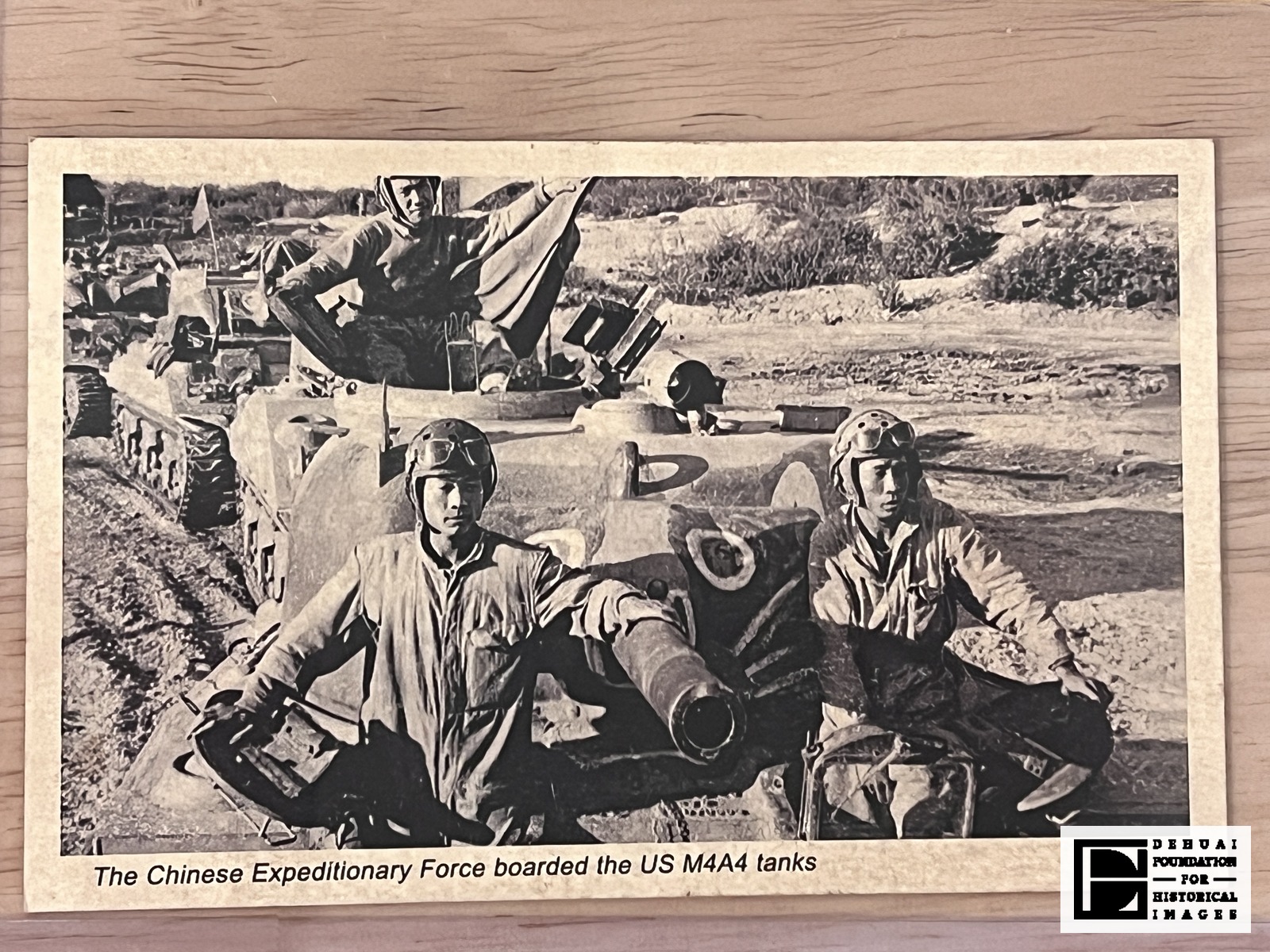
Photo card of soldiers on a tank, captioned “The Chinese Expeditionary Force boarded the US M4A4 tanks”
Three soldiers on a medium tank of Sherman type, photographed in bright, dry, stony country. Two sit on the front of the hull on either side of the gun barrel, both in padded tanker helmets…
The objectphotographed as held, uncropped
Catalogue description
Three soldiers on a medium tank of Sherman type, photographed in bright, dry, stony country. Two sit on the front of the hull on either side of the gun barrel, both in padded tanker helmets with goggles pushed up on the crown and in loose light-coloured field jackets; the man on the left rests a hand along the barrel, which points almost at the lens. A third leans out of the turret hatch behind and above them, arms braced on the roof. The left track run, the sponson line, a stowage box on the hull top and tow and lifting fittings are in frame. Behind the tank the ground rises in a bank of loose stone and low scrub; at the left edge are a small pale flag on a pole and further shapes that read as vehicles and figures in the middle distance. No unit marking, insignia or vehicle number is legible anywhere in the image.
The face carries one line of type, set in a bold italic sans-serif in the lower margin: The Chinese Expeditionary Force boarded the US M4A4 tanks. Nothing else is printed on the face — no photographer, agency, publisher, series number, copyright line or date — and the verso was not photographed. The card travels as an image and a sentence, and the sentence carries the whole of the identification.
The caption supplies the identification the picture does not. The men's nationality, the force they belong to and the model of the tank are all the caption's: no insignia is legible, and the features that would distinguish an M4A4 from another Sherman variant — the lengthened hull, the multibank engine deck — are outside the frame. The archive repeats those identifications as the caption's, not as its own. The English is also not idiomatic — “boarded the US M4A4 tanks” — and is transcribed as printed; who wrote the line, and whether it was written when the photograph was made or when this card was printed, is not established. Nor is the sense in which the caption uses “Chinese Expeditionary Force”: the name is applied inconsistently in the literature, sometimes to the 1942 Burma expedition and the Yunnan force specifically and sometimes to the whole Chinese effort in Burma, and the archive has not resolved which is meant here.
The image and the caption are printed together on one sheet, and the card is toned and cockled at the lower edge; how long after the photograph the card was made is unknown. Home-front material elsewhere in this accession — posters and magazines — addressed American donors and readers. Nothing on this card establishes its audience or connects it to that stream.
Transcriptiontext on the object, as printed
[Printed in the lower margin, below the image, in a bold italic sans-serif face:]
The Chinese Expeditionary Force boarded the US M4A4 tanks

[No other text appears on the face of the card: no title panel, credit or copyright line, series number, imprint, stamp, cancellation, signature or handwritten annotation. All four margins were cropped and read at full resolution and are blank. There is no Chinese-language text on the visible face. The verso was not photographed and is not transcribed.]
Historical context
The Chinese Expeditionary Force entered Burma in early 1942 alongside British forces; after Lashio fell on 29 April 1942 the campaign collapsed and part of the force withdrew into India, where it was retrained and re-equipped at Ramgarh. As X Force these India-based troops carried the advance back into northern Burma from October 1943, fought through the Hukawng Valley, took Myitkyina in August 1944 and opened the Ledo Road, the first convoy reaching Kunming in February 1945. A second Chinese force, given the South East Asia Command designation Y Force, attacked on the Yunnan front in the spring of 1944 under Wei Lihuang, crossing the Salween with some 75,000 men on a 300-kilometre front against the Japanese 56th Division. Chinese-crewed armour in this theatre was concentrated in the Chinese-American 1st Provisional Tank Group, activated at Ramgarh on 1 October 1943 under Colonel Rothwell H. Brown: six provisional tank battalions crewed by Chinese soldiers, with American contingents in the 1st and 2nd. It was first equipped with Lend-Lease M3A3 Stuart light tanks, and from April 1944 each company began to receive a platoon of five or six M4A4 Sherman mediums with 75 mm guns. The group fought at Maingkwan in March 1944, at Myitkyina, and at Bhamo, taken on 15 December 1944, and was deactivated on 18 December 1945. The M4A4 was the Sherman variant with a lengthened welded hull and a Chrysler A57 multibank engine, built largely for Lend-Lease; China was among the countries that received it. The tank-group facts in this paragraph rest on a researcher's compilation rather than on an official history, and have not been checked against the United States Army's China-Burma-India volumes.
What is not known
- No photographer, agency, publisher, printer, series number or date appears anywhere on the face of the card, so its origin, purpose and date are unestablished.
- The verso was not photographed. It is the most likely place for a publisher's imprint, a series or negative number, a collection stamp or a caption in Chinese; the record should not be read as saying the object is textless, only that the face is.
- The date of this printing is not established. The caption typeface reads as modern rather than as period letterpress, which is consistent with a later reproduction, but that is an impression from a photograph of the card and not evidence; the archive neither asserts nor denies that this is a wartime printing.
- Whether the caption was written by the original wartime source or by whoever printed this card is not established. Its non-idiomatic English is consistent with a translation but proves nothing about who made the card or where.
- The tank is not independently verified to be an M4A4 rather than another M4 variant. The vehicle reads as a Sherman-type medium, but the diagnostic features of the A4 — the lengthened hull, the multibank engine deck — are not in frame. The archive is repeating the caption's identification.
- The three soldiers are not identified and cannot be identified from this image. Their nationality and their formation come from the caption; no insignia, unit marking or vehicle number is legible at full resolution.
- Which force the caption's “Chinese Expeditionary Force” denotes is unresolved. The India-based Ramgarh-trained force (X Force) and the Yunnan force (Y Force) are distinguished in some accounts and run together under the same name in others; the archive has not settled the usage against a specialist history.
- The place is not stated on the object and is not established. The dry, stony, scrubby ground reads more like a training or staging area than the wet forest of the Hukawng Valley, but this is an impression from the image; the geo coordinate is a country-level anchor for Burma, the theatre most often associated with the force the caption names; the caption itself names no place, and if the Yunnan force is meant the ground could as easily be in China. The coordinate is not a location claim.
- The card was not measured and no scale reference is present in the photograph, so no dimensions are recorded.
- The printing process is not established: no halftone screen is resolvable at the available magnification, and the digital copy has been sharpened.
- Sources give different dates for Y Force's Salween operation — the fetched Wikipedia article places the attack in the second half of April 1944, while other accounts date the river crossing to the night of 11–12 May 1944. The archive has not resolved the discrepancy and states only 'the spring of 1944'.
- The Ramgarh training totals and the exact formation date of the Chinese Army in India, which appeared in the draft, have been removed: the archive could not re-verify them against a page it fetched.
- No original print, negative or accession number for this photograph has been traced; the archive has not matched it to a Signal Corps or news-agency original.
- Under whose command the Ramgarh retraining was conducted is not recorded here: the draft named Joseph Stilwell, but no source the archive fetched and listed carries that name, and the claim has been cut rather than left standing. It remains an open question for a later editor to source.
TFA-CA-137, “Photo card of soldiers on a tank, captioned “The Chinese Expeditionary Force boarded the US M4A4 tanks”,” Photograph not before 1944 if the caption's identification of the tanks is accepted; this printing undated. Picturing Chinese America — Tarita Foundation Archive, 2026. Accessed [date].