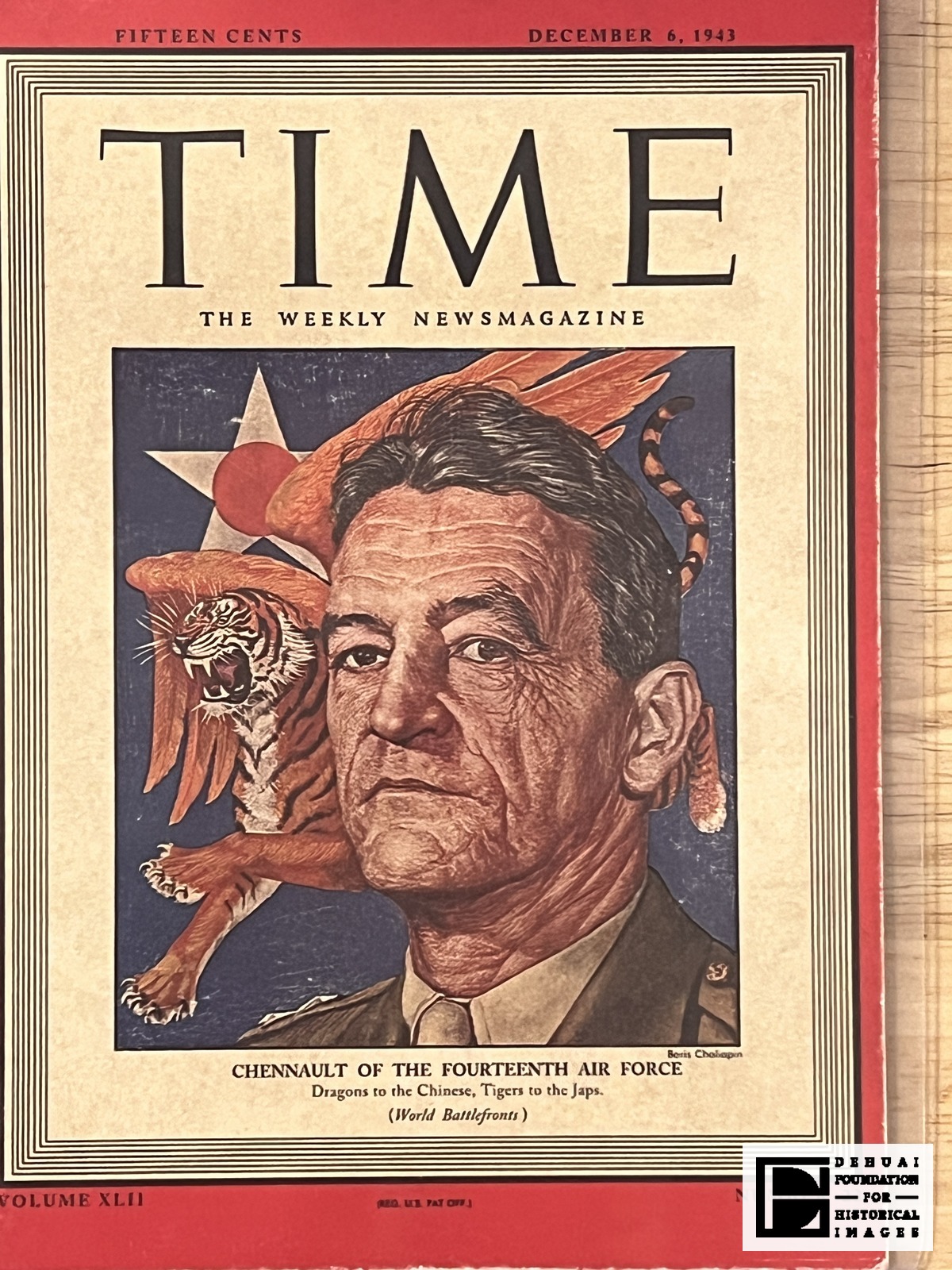
TIME, 6 December 1943: "CHENNAULT OF THE FOURTEENTH AIR FORCE / Dragons to the Chinese, Tigers to the Japs."
The cover of a single weekly issue. Inside the ruled cream frame and the red border sits a painted head-and-shoulders portrait of an older uniformed man, deeply lined, his gaze carrying…
The objectphotographed as held, uncropped
Catalogue description
The cover of a single weekly issue. Inside the ruled cream frame and the red border sits a painted head-and-shoulders portrait of an older uniformed man, deeply lined, his gaze carrying past the viewer rather than meeting it. He wears an olive tunic with a light shirt and tie; a small light-coloured metallic device sits high on the tunic at the sitter's left shoulder, well outboard of the lapel notch, which is bare. Behind him, against a dark blue ground, a snarling tiger is painted with an outspread wing rising from its shoulder and a long striped tail curling up past the man's ear; a large white five-pointed star and a red disc sit behind the tiger. A facsimile signature is printed on the cream border below the framed image, at the right.
The type does the naming. The printed caption identifies the sitter only by surname and command — CHENNAULT OF THE FOURTEENTH AIR FORCE — and the section tag (World Battlefronts) points the reader to the story inside. The line between them, "Dragons to the Chinese, Tigers to the Japs.", is the object's working sentence: it splits the two Asian populations of the war into a mythological register for the ally and a slur for the enemy, and hangs both on the same American officer. Chinese people appear in that sentence only as the people who supply him a metaphor.
This is an American weekly newsmagazine priced at fifteen cents, and this cover carries three elements: a painted portrait, a named commander, an animal emblem. The archive holds it as evidence of how the Chinese wartime alliance was rendered for a general American readership in late 1943 — the same three lines give the ally a mythological register and print "Japs" as ordinary editorial copy. The framing is worth naming plainly: the cover puts China in the caption as the setting and the source of imagery for an American commander's story, and the Chinese airmen, ground crews and civilians in that theatre do not appear on it.
The face of the copy is unmarked. No address label, subscriber stencil, newsstand mark, ownership signature or later annotation is visible on it, and nothing on the cover records where this copy circulated.
Transcriptiontext on the object, as printed
[Top red band, left:] FIFTEEN CENTS
[Top red band, right:] DECEMBER 6, 1943

TIME
THE WEEKLY NEWSMAGAZINE

[Printed facsimile signature on the cream border immediately below the framed painting, at right:] Boris Chaliapin

CHENNAULT OF THE FOURTEENTH AIR FORCE
Dragons to the Chinese, Tigers to the Japs.
[in italic:] (World Battlefronts)

[Bottom red band, left:] VOLUME XLII
[Bottom red band, centre, in very small type:] (REG. U. S. PAT. OFF.) [internal spacing and punctuation not resolvable at this resolution]
[Bottom red band, right:] NUMBER 23

[No manuscript notes, stamps, address label, subscriber stencil or other markings appear on this face.]
Historical context
A web reproduction of this issue's "World Battlefronts" article records that Claire Lee Chennault took over command of the Fourteenth Air Force's predecessor, the China Air Task Force, on 4 July 1942, then a brigadier general. His command was redesignated the Fourteenth Air Force during 1943; the activation date, his rank at that point and the location of its bases are not established by this record (see uncertainties). The Chinese-American Composite Wing — two P-40 fighter groups and one B-25 bombardment group, of four squadrons each, flown by Chinese aircrews trained under Lend-Lease — was activated on 1 October 1943, two months before this cover date, and served administratively under the Fourteenth Air Force. Its command structure was not a partnership of equals: the wing and each of its groups and squadrons was led by an American officer with a Chinese officer as deputy commander, and no Chinese vice commander of the wing arrived until April 1944. The issue date sits inside a tight sequence in the American framing of China. The Cairo Conference of 22–26 November 1943 brought Chiang Kai-shek together with Roosevelt and Churchill, and the Cairo Communiqué — promising that Japanese-occupied Chinese territory including Manchuria, Formosa and the Pescadores would be restored to the Republic of China — was released publicly on 1 December 1943, five days before this cover date. Eleven days after this issue's cover date, on 17 December 1943, the Magnuson Act was signed, repealing the Chinese Exclusion laws in force since 1882, permitting the naturalisation of some Chinese residents and setting an annual quota of 105 entry visas.
What is not known
- Only the front cover was photographed. The contents, the "World Battlefronts" article the caption points to, the masthead, the publisher's imprint and the printed place of publication are not visible on this object and are not transcribed here.
- The text quoted from the "World Battlefronts" article is taken from a web reproduction attributed to this issue; the interior of this copy was not photographed, so the pairing of that text with this object has not been verified.
- The extent, page count, binding method and dimensions of the issue were not observed; nothing about the condition of the interior or the back cover can be stated from one face.
- The direction of the sitter's gaze in the painting is not settled: the drafter read it as running to the viewer's right, the refuter as running to the viewer's left, and the gatekeeper's eye crops support the viewer's right. The description states only that the gaze carries past the viewer.
- The wording of the centred line in the lower red band, (REG. U. S. PAT. OFF.), is certain at full resolution; its internal spacing and punctuation are not — whether the imprint sets "U. S." with a space or "U.S." closed up cannot be resolved in this photograph.
- The identification of the printed surname CHENNAULT with Claire Lee Chennault rests on the external cover indexes listed in sources, not on anything else printed on this face.
- The cover artist is credited by TIME's own cover-archive page for this issue, and the facsimile signature printed below the image is consistent with that credit; beyond that credit the archive has established nothing about Boris Chaliapin. The National Portrait Gallery's Chaliapin exhibition page returned HTTP 403 to fetch attempts and is not cited here.
- Chennault's connection to the 1st American Volunteer Group, the "Flying Tigers," is not established by any source listed here and the claim has been cut from historical_context; it remains an open question for this record.
- The precise activation dates of the Fourteenth Air Force and the disbandment of the China Air Task Force are not established by this record. Search results give 10 March 1943 for the activation and 19 March 1943 for the disbandment, with one giving 5 March 1943 for an establishment at Kunming; no page carrying these dates was fetched, so historical_context says only that the redesignation took place during 1943. Chennault's rank at that point and the location of the Fourteenth Air Force's bases are likewise unestablished.
- The metallic device on the sitter's shoulder is unidentified, as are the white star and the red disc painted behind him. The winged tiger is the emblem associated with Chennault's command, but the archive has not verified the design's origin or authorship from a source.
- The geo coordinates are Kunming's and stand in for the theatre implied by the printed unit name; no place is printed on the object, the archive has not established from a fetched source where the Fourteenth Air Force was based, and the magazine itself was published in the United States.
- Nothing on the cover records this copy's provenance, distribution or later ownership.
TFA-CA-135, “TIME, 6 December 1943: "CHENNAULT OF THE FOURTEENTH AIR FORCE / Dragons to the Chinese, Tigers to the Japs.",” December 6, 1943 (printed on the cover). Picturing Chinese America — Tarita Foundation Archive, 2026. Accessed [date].