“CHINESE FRIENDS” bilingual card, with a CHINA RELIEF seal tied by a 1945 datestamp
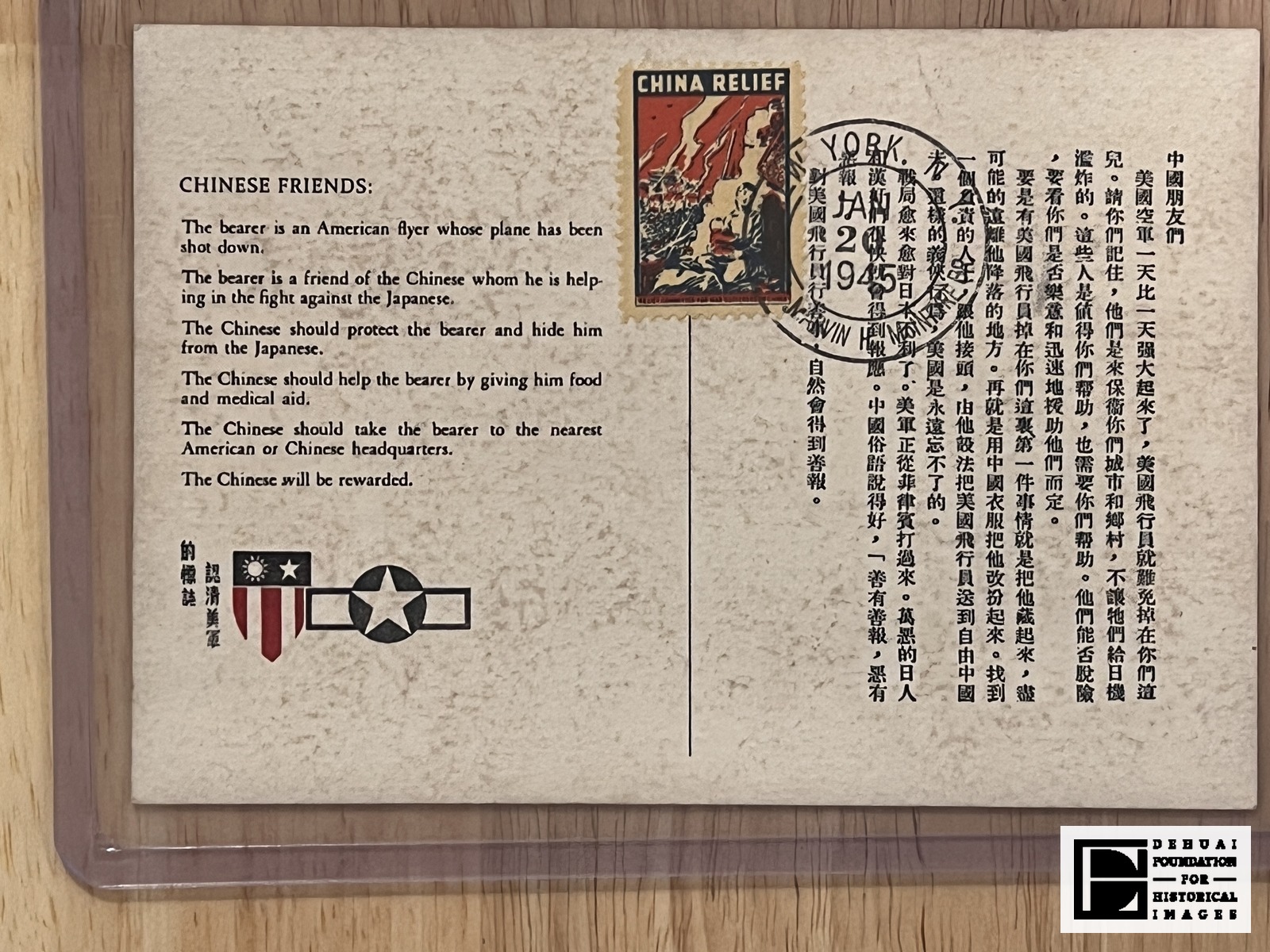
A card printed on two halves. On the left, six statements of English headed CHINESE FRIENDS: tell a reader what to do with the person carrying the card: he is an American flyer whose plane…
The objectphotographed as held, uncropped
Catalogue description
A card printed on two halves. On the left, six statements of English headed CHINESE FRIENDS: tell a reader what to do with the person carrying the card: he is an American flyer whose plane has been shot down, he is a friend of the Chinese, he should be protected and hidden from the Japanese, given food and medical aid, and taken to the nearest American or Chinese headquarters, and the Chinese will be rewarded. On the right, a longer Chinese text runs in thirteen vertical columns. It opens by telling Chinese readers that American airmen will inevitably come down where they are, states that these men have come to defend Chinese cities and villages from Japanese bombing, gives instructions — hide him, get him far from the place he landed, dress him in Chinese clothes, find a man whose description is obscured, make contact, and let him arrange to send the airman to Free China — and closes with a proverb about good repaid with good. At lower left the card prints two emblems side by side: a shield-shaped combined flag device whose dark upper band carries the Nationalist white sun at left and a single white five-pointed star at right, over vertical stripes in red and white, and the United States national aircraft insignia, with a Chinese caption reading 認清美軍的標誌 [Know clearly the insignia of the American forces].
The two texts are not translations of one another. The English is a set of instructions in the third person about a person the text calls the bearer, addressed to whoever reads it. The Chinese is an argument addressed to a reader who might find an airman — 要是有美國飛行員掉在你們這裏 [If an American airman comes down where you are] — and it asserts that the war is turning against Japan, that American forces are fighting their way over from the Philippines, and that the Japanese and the traitors will soon get their retribution. Where the English promises flatly that “The Chinese will be rewarded,” the Chinese converts that promise into a proverb about karma — 「善有善報,惡有惡報。」 [Good is repaid with good, evil is repaid with evil] — and then applies it to whoever helps an American airman. The card addresses its Chinese readers collectively, as 中國朋友們 [Chinese friends], in the same text that asks an individual reader to shelter a stranger.
This copy has a second thing on it. A perforated label lettered CHINA RELIEF — a charity seal, not postage — is affixed at the top of the card, and a circular black datestamp is struck across the label and onto the card, running over the Chinese text. The datestamp centre reads JA 2[0?] over 1945; its upper arc survives only as [illegible]YORK. and its lower arc as [illegible]ARVIN H MO[illegible]. The strike ties the label to the card. Who applied the seal, where, when, and in what order the seal and the strike were made is not established. No address, message or postage stamp appears on this face, and only this face was photographed, so there is no evidence the card travelled as mail. The record catalogues the object by physical format, as a postal cover — a card with an affixed label tied by a datestamp — and that classification settles nothing about who printed the card or why.
The archive has not established who printed the card, who applied the seal, or what the lettering in the lower arc of the datestamp says. Nothing on the photographed face names a publisher, printer, series or issuing agency. A second card carrying the same English and Chinese text is in this accession (object H); the two have not been compared side by side.
Transcriptiontext on the object, as printed
LEFT HALF, printed in English:
CHINESE FRIENDS:
The bearer is an American flyer whose plane has been
shot down.
The bearer is a friend of the Chinese whom he is help-
ing in the fight against the Japanese.
The Chinese should protect the bearer and hide him
from the Japanese.
The Chinese should help the bearer by giving him food
and medical aid.
The Chinese should take the bearer to the nearest
American or Chinese headquarters.
The Chinese will be rewarded.

LOWER LEFT, in two short vertical columns beside the flag device and the aircraft insignia:
認清美軍的標誌 [Know clearly the insignia of the American forces]

RIGHT HALF, printed in Chinese, thirteen vertical columns reading right to left (a title column and twelve columns of text):
中國朋友們 [Chinese friends]
美國空軍一天比一天強大起來了,美國飛行員就難免掉在你們這兒。請你們記住,他們是來保衛你們城市和鄉村,不讓牠們給日機濫炸的。這些人是值得你們幫助,也需要你們幫助。他們能否脫險,要看你們是否樂意和迅速地援助他們而定。 [The American air force grows stronger by the day, and American airmen will inevitably come down where you are. Please remember that they have come to defend your cities and villages, to keep them from being bombed indiscriminately by Japanese aircraft. These men are worth your help, and they need your help. Whether they get out of danger depends on whether you are willing to help them, and quickly.]
要是有美國飛行員掉在你們這裏第一件事情就是把他藏起來,盡可能的遠離他降落的地方。再就是用中國衣服把他改扮起來。找到一個[?][?]的人,跟他接頭,由他設法把美國飛行員送到自由中國去。這樣的義俠行為,美國是永遠忘不了的。 [If an American airman comes down where you are, the first thing is to hide him, as far as possible from the place where he landed. Next, dress him in Chinese clothes. Find a [?] [?] man, make contact with him, and let him arrange to send the American airman to Free China. Such a righteous and gallant act America will never forget.] — two characters between 一個 and 的人 are obscured by the datestamp and are not read here.
戰局愈來愈對日本不利了。美軍正從菲律賓打過來。萬惡的日人和漢奸[?]快[?]得到報應。中國俗語說得好,「善有善報,惡有惡報。」 [The course of the war turns more and more against Japan. American forces are fighting their way over from the Philippines. The utterly evil Japanese and the traitors [?] will soon get their retribution. The Chinese saying puts it well: “Good is repaid with good, evil is repaid with evil.”] — two characters in this column are struck through by the datestamp; see uncertainties for the two competing readings.
對美國飛行員行善的,自然會得到善報。 [Whoever does good to American airmen will naturally receive a good recompense.] — set as a separate final column.

AFFIXED LABEL, top centre-right, perforated, printed in red, a dark ink that reads navy-to-black in this photograph, and cream:
CHINA RELIEF
[design: massed figures beneath streaming flags; a large foreground figure at right with a smaller figure before it; a band across the foot of the design carries a line of small lettering that is not resolvable at this resolution: [illegible]]

CIRCULAR DATESTAMP struck across the label and the card, black:
[upper arc:] [illegible]YORK.
[centre:] JA 2[0?]
1945
[lower arc:] [illegible]ARVIN H MO[illegible]
Historical context
A blood chit is a notice carried by military personnel and addressed to civilians, identifying the bearer's force as friendly and asking that he be given assistance; the best-known Second World War examples are the chits carried by American airmen in China, whose standard text described the bearer as a foreigner who had come to China to help in the war and asked that soldiers and civilians alike rescue and protect him. Those chits were made of cloth, about the size of a handkerchief, and carried on the person or sewn into flight clothing. This object is a printed card, and the archive has not established whether it was issued to aircrew or produced on the American home front. The United States national aircraft insignia printed on the card — the star in a disc with a rectangular bar on each side — was ordered on 28 June 1943, when bars were added to the roundel with an Insignia Red outline; the red outline was replaced with Insignia Blue by amendment of specification AN-I-9 on 14 August 1943. The insignia here is printed in outline with no border colour, so only the June 1943 order gives the card a date before which it cannot have been printed. Relief for China on the American home front was organised chiefly through United China Relief, formed when several existing China aid organisations joined forces after the outbreak of the Sino-Japanese conflict, with a fundraising goal of five million dollars. Labels of the kind affixed to this card — stamp-shaped, perforated, printed by businesses, churches, political groups and non-profits, and carrying no postal validity — are what philately calls cinderella stamps; charity seals such as Christmas and Easter seals fall within the category. The seal on this card names only the cause, CHINA RELIEF, and the archive has not tied it to a particular organisation.
What is not known
- No publisher, printer, issuing body, series number or printing date appears on the photographed face. Whether the card was printed by a United States military agency for issue to aircrew or produced in the United States as a home-front souvenir or fundraising piece is not established, and the dc_type assignment (Postal Cover) describes format only and does not settle it.
- The date of this printing is not established. The card cannot have been printed before 28 June 1943; the 1945 datestamp dates the addition of the seal, not the printing, and how long after 1943 the card was printed is unknown.
- The upper arc of the datestamp survives only as [illegible]YORK.; the letters before it fall on the seal and are not legible. NEW YORK is a plausible reading but nothing of it is visible in the ink, and York, Pennsylvania and other York post offices exist. The archive names no place for the datestamp, and geo records only China, the place the card's text addresses.
- The day digit in the datestamp is overprinted by Chinese type. The month abbreviation reads JA with no third letter; the day reads 2 followed by a rounded glyph best read as 0, with 9 not excluded.
- The lettering in the lower arc of the datestamp reads only as [illegible]ARVIN H MO[illegible]; the rest runs under printed Chinese type. Whether it is a person's name, a firm or a cachetmaker is not established, and a search of philatelic sources identified no dealer, society officer or postal station matching it. Whether the marking is a post office cancel or a private handstamp is unresolved.
- Two characters in the third Chinese paragraph are struck through by the datestamp. The archive's two independent readers differed: one read 萬惡的日人和漢奸很快會得到報應 [the utterly evil Japanese and the traitors will very soon get their retribution], the other 萬惡的日人和漢奸都快[要?]得到報應 [the utterly evil Japanese and the traitors are all about to get their retribution]. The editor's own crop confirms 和漢奸 [and the traitors], 快 [soon] and 得到報應 [get their retribution] but cannot decide the two obscured slots, which are transcribed [?].
- Two characters between 一個 and 的人 in the second Chinese paragraph are struck through by the datestamp. The lower of the two shows a 貝 element at its foot; a reading of 責, giving 一個負責的人 [a responsible man], is possible but is not established, and the re-reader's proposal 誠 [sincere or loyal], giving 一個忠誠的人 [a loyal man], assumed a single slot. Both characters are transcribed [?].
- The line of small lettering across the foot of the CHINA RELIEF label, which may name the issuing organisation, is not resolvable at this capture resolution. The archive has not tied the label to United China Relief or to any other named body.
- The verso was not photographed, so any address, message, dealer mark or collector note on the back is unrecorded, and the inference that the card did not travel as mail rests on one face only.
- The relationship to the other “CHINESE FRIENDS” card in this accession (object H) is one of shared text. The two have not been collated, and whether they are two printings of one setting of type or two separate settings is not established.
- The Chinese text's reference to American forces fighting their way over from the Philippines is transcribed but is not used to date the card; no source for that campaign was fetched.
- The dark upper band of the flag device at lower left, and the dark ink of the CHINA RELIEF label, read dark in this photograph; whether either is printed black or blue cannot be judged from the image.
TFA-CA-133, ““CHINESE FRIENDS” bilingual card, with a CHINA RELIEF seal tied by a 1945 datestamp,” Card undated; on the evidence of the United States national aircraft insignia it prints, it cannot have been printed before 28 June 1943. The affixed seal is tied by a circular datestamp reading JA 2[0?] / 1945. Picturing Chinese America — Tarita Foundation Archive, 2026. Accessed [date].