Chinese Camp, Brown’s Station, Nevada
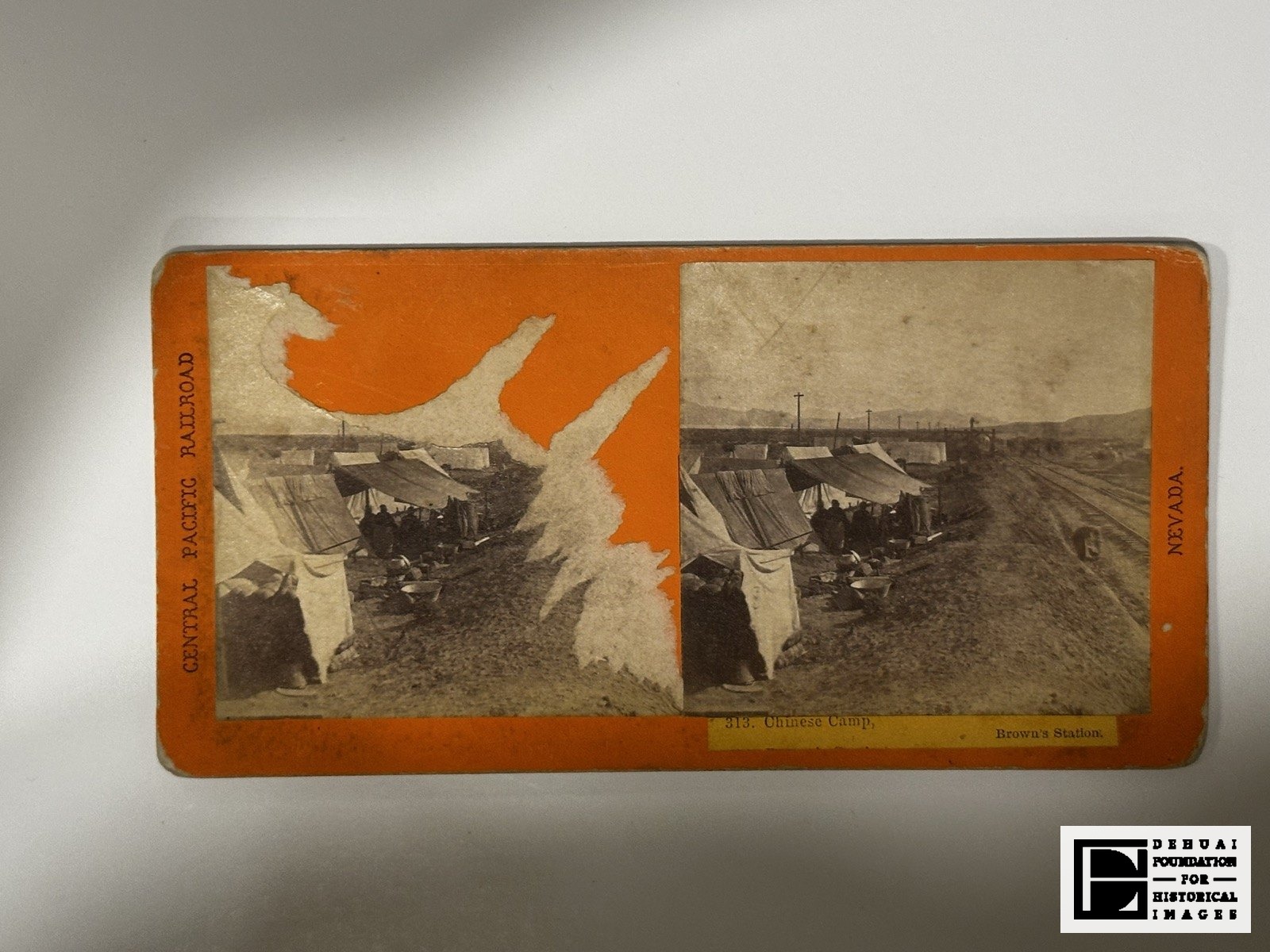
A camp on open ground beside the railroad grade: canvas tents and a low board structure, bedding and equipment heaped at the entrances, and a group of men standing among them looking toward…
The objectphotographed as held, uncropped
Catalogue description
A camp on open ground beside the railroad grade: canvas tents and a low board structure, bedding and equipment heaped at the entrances, and a group of men standing among them looking toward the camera. The line of the track runs across the upper part of the frame. The ground is bare and the horizon is empty in every direction.
This is one of the very few photographic records of how the men who built the Central Pacific actually lived. The Chinese workforce on the line — which at its height numbered in the thousands and made up the large majority of the construction labor — moved with the grade, camping where the work was. What the card shows is the domestic fact of that: canvas, bedding, ground.
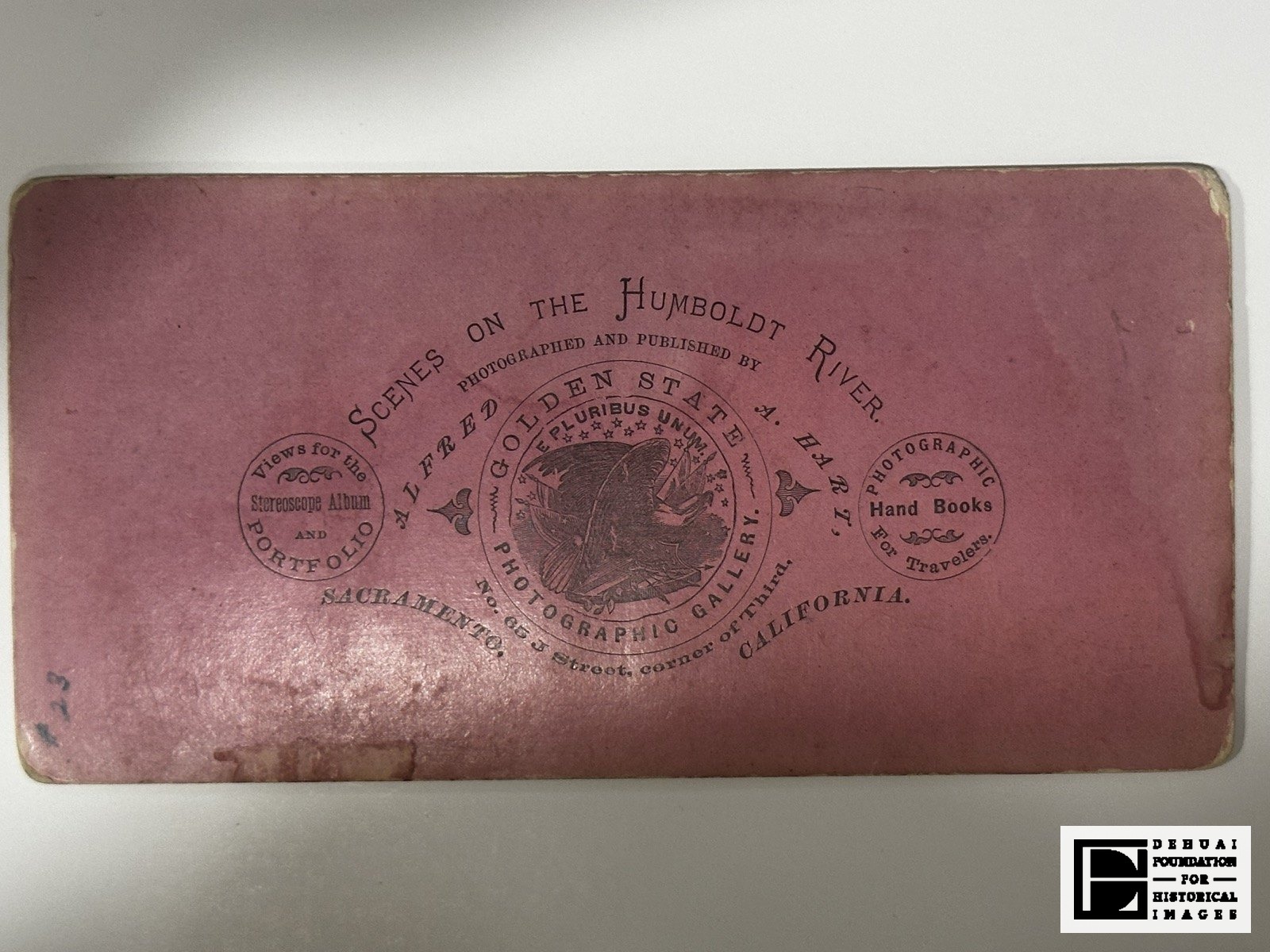
The verso identifies the maker as Alfred A. Hart of Sacramento, and places the view in a series called Scenes on the Humboldt River. Hart was the official photographer of the Central Pacific during construction. These images were commissioned by the railroad and sold as views of a triumph; the camp is in the catalogue because the company was documenting its own progress, not because anyone set out to record the workers’ lives.
Transcriptiontext on the object, as printed
FACE:
NEVADA.
CENTRAL PACIFIC RAILROAD
313. Chinese Camp,   Brown’s Station.

VERSO:
SCENES ON THE HUMBOLDT RIVER.
Photographed and published by A. HART,
ALFRED A. HART
GOLDEN STATE PHOTOGRAPHIC GALLERY.
No. 65 J Street, corner of Third, SACRAMENTO, CALIFORNIA.
Photographic Hand Books For Travelers.
Views for the Stereoscope Album and PORTFOLIO.
Historical context
Alfred A. Hart (1816-1908) made several hundred stereographs documenting the construction of the Central Pacific Railroad between 1864 and 1869. Chinese workers formed the overwhelming majority of the Central Pacific’s construction workforce, worked for lower wages than white workers, and struck for better pay and hours in June 1867. They were almost entirely absent from the ceremonial photographs made at Promontory Summit in May 1869.
What is not known
- Date is inferred from the progress of Central Pacific construction across Nevada and from Hart’s Sacramento address; no date is printed on the object.
- The pairing of this face and verso rests on the two being photographed in sequence and on the Humboldt River series matching the Nevada location; the mount face reads orange and the verso pink in the source photographs, which is consistent with a single card under different light but has not been confirmed against the object.
- None of the men in the camp is identified.
TFA-CA-103, “Chinese Camp, Brown’s Station, Nevada,” c. 1868-1869. Picturing Chinese America — Tarita Foundation Archive, 2026. Accessed [date].